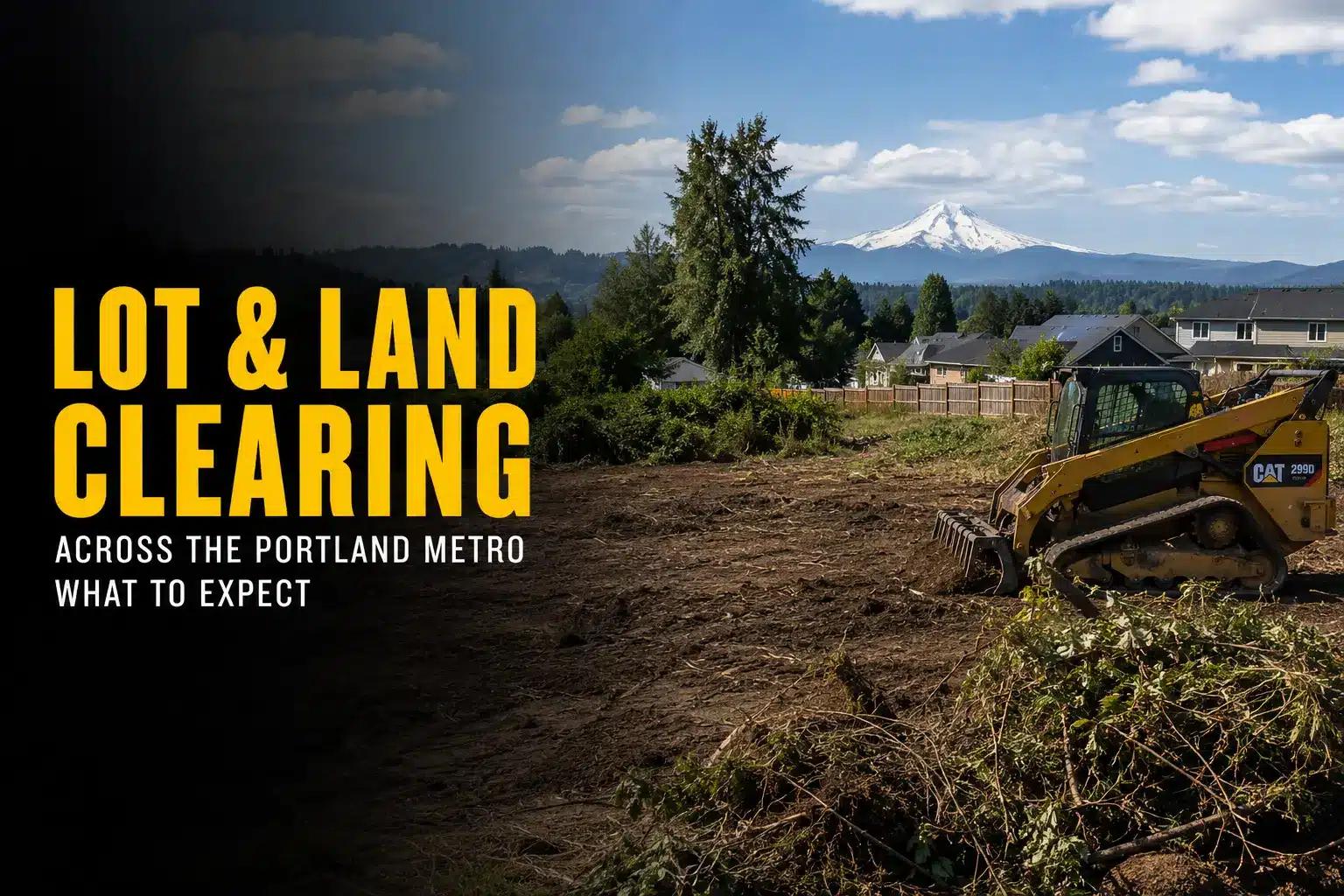
Lot clearing in the Portland metro area is not a one-size-fits-all job. The vegetation is different in Sherwood than it is along the creek corridors in Tualatin. Lake Oswego has specific tree codes that change what a clearing crew can and cannot do without permits. Tigard lots off Bull Mountain look completely different from flat Tualatin industrial parcels. And across all of them, Himalayan blackberry, English ivy, and overgrown brush have a way of turning what looks like a straightforward clearing job into something that takes longer than the first quote suggested.
This is what lot and land clearing actually involves in the south and southwest Portland metro: what to expect from the process, what questions to ask, and what is specific to the communities we work in most.
What Lot Clearing Actually Involves
Lot clearing is not a single task. It is a sequence of work that varies significantly based on what is on the property and what condition you need to leave it in. A lot being cleared for new residential construction has different requirements than a neglected commercial parcel being prepared for sale. An overgrown residential lot with blackberry and ivy is a different job from a wooded lot with mature Doug fir and undergrowth.
The typical sequence for vegetation-heavy lot clearing starts with surface brush removal: cutting and hauling all above-ground growth, including blackberry canes, ivy runners, thistle, and similar invasive vegetation. This phase is the most physically intensive and sets up everything that follows. Once the brush canopy is down, the scope of the root system problem becomes clear and root extraction or stump grinding can be properly assessed.
For lots that are going into construction or sale, debris hauling matters as much as the clearing itself. Everything that comes off the lot needs to go somewhere. A clearing quote that does not explicitly include haul-off is a quote that will have add-ons. Ask upfront what the debris disposal covers and what it does not.
We handled a lot clearing job in Sherwood last year for a homeowner preparing a half-acre parcel for sale. The property had been unmanaged for six years: blackberry wall across the rear third, ivy through the understory trees along the east boundary, and a section of English laurel that had grown to fifteen feet. Three crew days, two full trailer loads, and proper root work on the blackberry section. The parcel listed clean within two weeks of the job finishing. That sequence of clear, haul, root work, done is what most south metro lot clearing jobs look like when they are done properly. See our full range of property services across the tri-county area.
What Changes City to City in the South Metro
Sherwood
Sherwood lots tend to be larger and more rural-feeling than the closer-in suburbs, with more established tree cover and a higher likelihood of blackberry and ivy infestations that have been running unchecked for several seasons. The Tualatin River corridor near Sherwood also means some parcels sit near wetland buffers where vegetation removal has additional restrictions. For lots near Tualatin River National Wildlife Refuge boundaries or Clean Water Services buffer zones, check setback and vegetation removal requirements before scheduling clearing work.
Tualatin
Tualatin has a mix of residential lots and commercial and industrial parcels, and the clearing work we do there reflects that. Flat industrial parcels with blackberry encroachment along the perimeter are common, as are residential lots in established neighborhoods where the rear portions have been neglected for years. Tualatin’s tree removal rules allow up to four trees per year to be removed on private residential property without a permit, unless the tree is a Heritage Tree, in a wetland, or in a Clean Water Services vegetated corridor. Anything beyond that threshold or in a regulated area requires a permit before work starts.
Tigard
Tigard‘s lot clearing work is heavily concentrated in the Bull Mountain area and along the Fanno Creek greenway corridor. Hillside lots off Bull Mountain are among the more physically demanding clearing jobs in the south metro. Steep grade, limited equipment access, and blackberry that has established itself on slopes where root extraction is genuinely difficult all add to the complexity. Fanno Creek-adjacent properties also require awareness of CWS vegetated corridor buffers, which restrict what can be cleared within a set distance of the creek and its tributaries.
Lake Oswego
Lake Oswego has some of the more detailed tree codes in the metro area. The city’s tree code covers tree removal on both public and private property, and larger trees often require either a Type 1 or Type 2 permit before removal. Type 2 removals require an application process and in some cases a public notice. For lot clearing jobs that involve removing significant trees in Lake Oswego, confirming permit requirements before scheduling work is essential. The timeline of permits is a real part of the project scope and should not be discovered after a crew is already on site.
Lake Oswego lots along the lake itself and in the hillside neighborhoods also tend to have slope and access considerations that extend the job. Properties with retaining walls, tiered landscaping, or limited truck access require hand-clearing and extended labor time that flat-lot jobs do not.
South Metro Lot Clearing: City Comparison
| City | Common Lot Characteristics | Key Considerations |
| Sherwood | Larger lots, established tree cover, rural feel | Wetland buffers near Tualatin River corridor; CWS setback requirements |
| Tualatin | Mix of residential and commercial parcels, flat terrain | 4 tree per year removal limit without permit; Heritage Tree and wetland exceptions |
| Tigard | Bull Mountain slopes, Fanno Creek corridor proximity | Steep access challenges; CWS vegetated corridor buffer restrictions |
| Lake Oswego | Hillside and lake-adjacent lots, tiered landscaping | Type 1 and Type 2 tree permits required for significant removals; detailed city tree code |
The Invasive Vegetation Problem Across All Four Cities
The single most consistent factor across Sherwood, Tualatin, Tigard, and Lake Oswego lot clearing jobs is Himalayan blackberry. It is present on the majority of neglected lots across the south metro, often combined with English ivy, morning glory, or Canada thistle. The Washington County Soil and Water Conservation District identifies Himalayan blackberry as the most widespread and disruptive noxious weed in western Oregon, and the south metro lot clearing market reflects exactly that. Almost every overgrown lot we walk has it in some form.
The reason invasive vegetation matters for lot clearing specifically is that it changes the job scope in ways that are not always obvious from a visual estimate. A lot that looks like a simple brush clearing job from the street can have blackberry root crowns eighteen to twenty-four inches underground across the entire rear section. That is a meaningfully different job from brush that can be cut and hauled without root extraction. The only way to know what is actually there is to walk the property and dig in a few spots.
For lots being prepared for construction, leaving root crowns in the ground creates problems down the line: regrowth through new landscaping, root interference with foundation work, and invasive vegetation competing with any plantings that go in after the clearing. For lots being prepared for sale, surface clearing without root work looks good initially but creates a disclosure question once the regrowth appears. Doing the root work once, properly, avoids both problems.
Questions to Ask Before You Hire a Clearing Crew
The gap between a good lot clearing job and a frustrating one usually comes down to what was and was not included in the original quote. Ask every crew the same set of questions before you compare their numbers.
Does the quote include root removal for invasive plants like blackberry and ivy, or just surface cutting? Does it include debris haul-off, dump fees, and final cleanup, or just the clearing labor? If the lot has trees, has the crew confirmed whether permits are required for your specific city and lot, and is permit handling included in the job or separate? Is the crew insured for property damage and licensed for any herbicide application if chemical treatment is part of the plan?
A lower quote that does not include haul-off, root work, or permit handling is not a lower price for the same job. It is a lower price for a different and less complete job, and the gap shows up when the regrowth appears or when you are stuck managing debris that was not removed.
We cleared a Tualatin commercial parcel last spring where the property owner had previously gotten two quotes that looked similar on paper. Both excluded haul-off. When we gave our estimate including full debris removal and root work on the blackberry perimeter, it was higher. But it was also the complete job. After we finished, the site sat clean. The two lower quotes would have left a debris pile on the property and blackberry that came back through the season. Get specifics before you sign anything. Our blackberry and overgrowth removal service covers what is included in every Billy Goat job.
Get Your Free Estimate
Billy Goat Property Services has been clearing lots and overgrown properties across Sherwood, Tualatin, Tigard, Lake Oswego, and the wider Portland tri-county area for 18 years. We walk every property before quoting, tell you exactly what the job involves, and include debris haul-off and root work in our numbers so there are no surprises after the job starts. Call 503-783-4747 or get your free estimate here.
Common Questions About Lot Clearing in the Portland Metro
Do I need a permit to clear my lot in Lake Oswego or Tigard?
It depends on what is being removed. Lake Oswego has specific tree codes requiring permits for larger trees, with Type 2 removals requiring an application and sometimes public notice. Tualatin allows up to four tree removals per year on residential private property without a permit, with exceptions for Heritage Trees and trees in wetland or Clean Water Services buffer areas. Tigard and Sherwood have their own requirements. Confirming permit requirements for your specific city and lot before scheduling work is essential. A good clearing crew will know what to check and flag it during the estimate.
How long does a typical lot clearing job take in the south Portland metro?
A typical overgrown residential lot under half an acre takes one to two crew days depending on density, access, and whether root extraction is involved. Larger properties or jobs with significant blackberry root systems, slope work, or limited equipment access take longer. Commercial parcels vary widely. The estimate process gives you a realistic timeline before work starts.
What is the difference between lot clearing and blackberry removal?
Blackberry removal is one component of lot clearing. Lot clearing typically addresses the full range of vegetation on a property: blackberry, ivy, overgrown shrubs, brush, and in some cases trees. It is usually scoped for a property that needs to be brought to a clean, usable state rather than just addressing a specific invasive plant. If the primary problem on your lot is blackberry, our blackberry removal service is the right starting point. If the lot has a mix of vegetation types and needs to be fully cleared, that is a lot clearing job and we will scope it accordingly.
Does Billy Goat handle lot clearing for commercial properties in Tigard and Tualatin?
Yes. We work with commercial property owners, landlords, and investors across the south Portland metro on lot clearing, property restoration, and ongoing vegetation management. Commercial parcels in Tigard and Tualatin make up a significant part of our work, particularly properties with blackberry encroachment along perimeters or lots being prepared for lease or sale. Call 503-783-4747 or get a free estimate and we will walk the property and give you a clear scope before anything starts.
What happens if permits are required before clearing can start?
We flag permit requirements during the estimate walk so you know about them before any work is scheduled. In cities like Lake Oswego where tree permits involve an application process, factoring the permit timeline into the project schedule upfront avoids delays. We can advise on what is typically required for your lot and city, though the permit applications themselves are the property owner’s responsibility to submit.
Does Billy Goat clear lots near wetlands or creek corridors?
Yes, but those jobs require extra care around Clean Water Services buffer zone requirements and any applicable DEQ or county setback rules. We are familiar with the Fanno Creek, Tualatin River, and Johnson Creek corridors and what can and cannot be cleared within regulated buffer distances. For properties near water features, we walk the site carefully before quoting and make sure the scope of work stays within what the regulations allow. Contact us to discuss your specific property.
An overgrown lot does not get easier to clear the longer it sits. Call 503-783-4747 or get your free estimate from Billy Goat Property Services and let us walk the property with you and give you a clear picture of what the job involves.