
If you are dealing with a thorny patch that keeps coming back no matter how much you cut, you are not imagining it. The reason why blackberry bushes are hard to remove is not just the canes you see above ground. The real fight is happening below the soil, where the plant stores energy, spreads sideways, and prepares to come back again.
The good news is that blackberry removal can work when you use the right method, the right timing, and the right follow-up. This guide shows you what is really going on, what actually works, and when it makes sense to call for professional help in Portland.
Blackberry bushes are hard to remove because cutting the top growth does not kill the plant. In many cases, the root crown, rhizomes, tip-rooted canes, and even long-lived seeds allow the patch to come back fast.
What works best is full root-zone removal or a repeat control plan that keeps new shoots from feeding the roots again.
Why Blackberry Bushes Keep Coming Back
On many Portland properties, the main problem is Himalayan blackberry, also called Armenian blackberry. Oregon classifies it as a B-listed noxious weed, which tells you how widespread and troublesome it is in the state.
It is not just a messy yard plant. It spreads aggressively, crowds out other plants, and turns manageable spaces into thick, painful, hard-to-access thickets.
Oregon State Extension notes that a single plant can turn into a large thicket in less than two years, which helps explain why a small problem often becomes a major one so quickly.
The biggest reason removal fails is the blackberry root system. These plants resprout vigorously from rhizomes and root crowns, so a quick cut at ground level usually gives you a cleaner-looking patch for a short time, not a dead plant.
Canes can also root at their tips and nodes, which means stems touching soil can start new plants. On top of that, Himalayan blackberry can produce large numbers of seeds, and those seeds can stay viable in the soil for years. That is why blackberry regrowth can show up even after you think the area is finally clear.
Another reason these bushes are so frustrating is access. The thickets are dense, thorny, and often wrap through fences, shrubs, slopes, sheds, and edges of buildings. By the time most homeowners act, they are not dealing with one plant.
They are dealing with a layered patch with old canes, new shoots, underground spread, and hidden root zones that are hard to reach safely.
What Works to Get Rid of Blackberry Bushes
What works depends on how large the patch is and how badly it has spread. But in most cases, the best results come from a process, not a one-time cut.
1. Remove the Top Growth
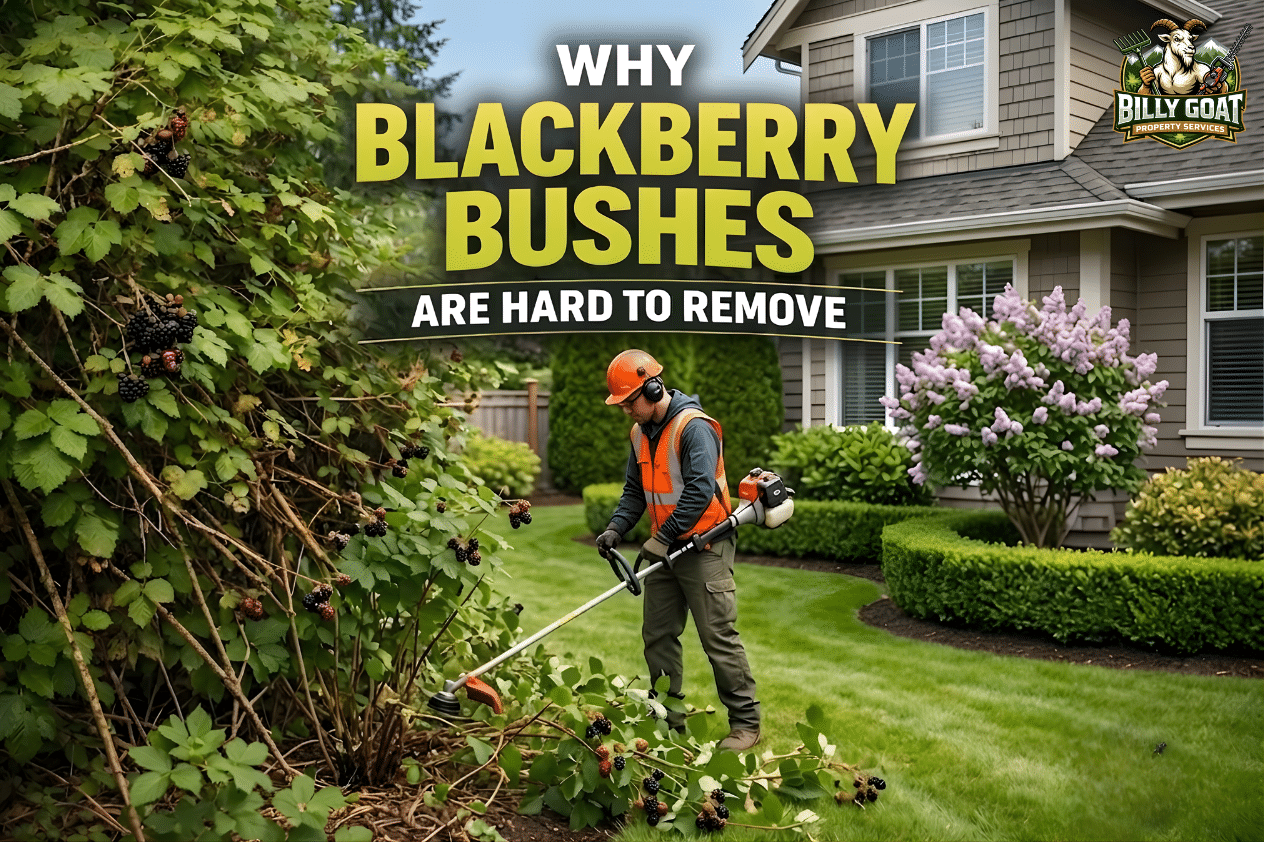
For small patches, that may mean hand-cutting canes close to the ground. For large infestations, mechanical cutting may be faster. This first pass is about gaining access, not finishing the job. If you stop here, the plant usually comes back.
2. Go After the Crown and Root Zone
Cutting followed by digging up root crowns is one of the most effective control methods. This is the step many people skip, and it is the reason so many DIY jobs fail. You do not need to remove every tiny root hair, but you do need to remove the crown and major root structure that powers new shoots. If the patch is mature, this can be slow, heavy work.
3. Follow Up with Ground Cover
Do not leave the site bare and forget it. Soil disturbance can create a good seedbed for new seedlings, so cleared areas often need follow-up planting or strong ground cover. Extension guidance recommends replanting with hardy perennials or grasses to help outcompete fresh shoots and reduce the chance of the patch taking over again. A cleared patch without follow-up is often just a pause button.
4. Expect Repeat Monitoring
If digging is not possible everywhere, repeated mowing or repeated cutting can weaken the plant by removing leaves over and over until the roots lose stored energy. This can work, but it takes persistence over time. A single mow or one weekend of cutting almost never solves it. In bigger infestations, follow-up visits are often part of what makes removal stick.
5. Handle Debris Properly
Be careful with debris. Cut canes, especially those touching soil, can help the plant spread if they are left in the wrong place. A proper cleanup matters. Hauling, disposal, fence-line clearing, and protecting nearby plants are part of a real blackberry removal plan, not extra details.
For very large, steep, or dangerous sites, professionals may combine cutting, digging, haul-away, and follow-up management. In some cases, where allowed and appropriate, licensed treatment methods may also be part of a broader control plan.
For chemical treatment, Billy Goat coordinates with licensed third-party applicators in compliance with Oregon state regulations.
DIY vs Professional Blackberry Removal: Which One Makes More Sense?
DIY removal can work when the patch is small, isolated, and easy to access. If you have a few young plants in open soil, you may be able to cut them down, dig out the crowns, clean the debris, and stay on top of any new shoots.
DIY also makes sense when you are patient enough to do repeat follow-up, because that is where many homeowners lose the battle.
But professional help becomes the smarter option when the patch is large, mature, or tangled into fences, slopes, buildings, creek edges, or valued landscaping. Dense blackberry growth can hide holes, debris, sharp canes, and unstable footing.
It is also physically demanding to cut, drag, dig, and haul without turning the job into a multi-week struggle. Professionals are usually better equipped to assess the depth of infestation, protect desirable plants, clear tight areas, and plan for regrowth control instead of just surface cleanup.
Another big difference is follow-through. Many service providers in the Portland area make it clear that Blackberry removal is not a quick trim job. The real goal is to reclaim the property and manage regrowth properly.
That matters because blackberry regrowth is where unfinished jobs reveal themselves. If you only want the area to look better for a week, DIY cutting may be enough. If you want the patch actually under control, a professional plan is often the better value.
How Much Does Blackberry Removal Cost in Portland, OR?
Blackberry removal in Portland is usually priced on a case-by-case basis because no two properties are alike.
Contractors often quote after looking at the size of the patch, how dense it is, whether the roots need digging, how easy the site is to access, and how much debris needs to be hauled away.
Local blackberry and brush clearing companies in the Portland area commonly offer free estimates instead of fixed published pricing, which is a sign that site conditions drive the final number.
For a budgeting benchmark, Angi’s current Portland land-clearing data puts the average project around $2,887, with many jobs falling between $1,529 and $4,244. That is not a universal blackberry-only rate, but it is a useful local starting point for understanding what overgrowth removal can cost in the city. Smaller patches can come in lower, while steep slopes, fence-line work, deep root removal, limited machine access, and heavy haul-away can push costs higher.
If your patch is covering a wide lot, wrapping through structures, or has been ignored for years, expect labor and disposal to matter as much as cutting.
A cheap surface trim may look attractive at first, but if the crown stays in place and the job has no follow-up, you may end up paying twice. In most cases, the better question is not just what the first visit costs. It is what it costs to actually stop the problem from coming back.
Need Professional Blackberry Removal in Portland? Billy Goat Can Help
If blackberry has taken over your yard, fence line, or overgrown lot, Billy Goat Property Services serves Portland property owners who need more than a quick cutback.
With 18+ years of transforming Portland properties, the company describes its work as identifying the infestation, clearing dense patches, removing canes from problem areas, handling debris, and managing regrowth with proper follow-up.
If you want the area usable again, safer to walk through, and less likely to disappear under fresh canes a few weeks later, getting a professional estimate is the fastest next step.
FAQ
Do blackberry bushes come back after cutting?
Yes, very often. Cutting the canes removes the visible growth, but it usually does not kill the root crown or rhizomes. That is why a patch can look cleared and then send up new shoots not long after. Repeated cutting can weaken the plant over time, but full removal usually requires dealing with the crown and root zone, too.
How deep is the blackberry root system?
The more important issue is not extreme depth, but persistence and spread. Blackberry plants resprout from root crowns and rhizomes, and those underground parts store enough energy to fuel fresh growth after the canes are cut. That is why people often underestimate the underground part of the plant.
What is the best way to stop blackberry regrowth?
The best long-term approach is to remove the top growth, dig out the root crown and major roots where possible, clean the debris, and then monitor the area for new shoots. Replanting the cleared area with competitive plants can also help reduce blackberry regrowth. If digging is not realistic, repeated mowing or repeated cutting can still work, but only with consistent follow-up.
Can I remove blackberry bushes myself?
Yes, if the patch is small and accessible. But large or mature infestations are much harder than they look. Thick thorns, hidden canes, rooted tips, heavy debris, and root-zone digging can make the work slow and rough. If the patch is wrapped through structures, on a slope, or keeps returning after you have already tried, professional removal is usually the better call.
Is Himalayan blackberry a problem in Oregon?
Yes. Oregon lists the Armenian, also called Himalayan, blackberry, as a B-listed noxious weed. It is widespread, economically important, and known for spreading aggressively in many parts of western Oregon, including unmanaged and disturbed areas.
Conclusion
Blackberry removal is frustrating because the plant is built to survive quick fixes. When you understand the crown, rhizomes, seeds, and repeat growth pattern, the problem starts to make sense. What works is not random cutting.
It is a real control plan with removal, cleanup, and follow-up. If you are tired of fighting the same patch over and over, now is the right time to request a free estimate for blackberry removal in Portland and get the problem handled the right way.
Call Billy Goat Property Services at 503-783-4747 or visit tamemyjungle.com