
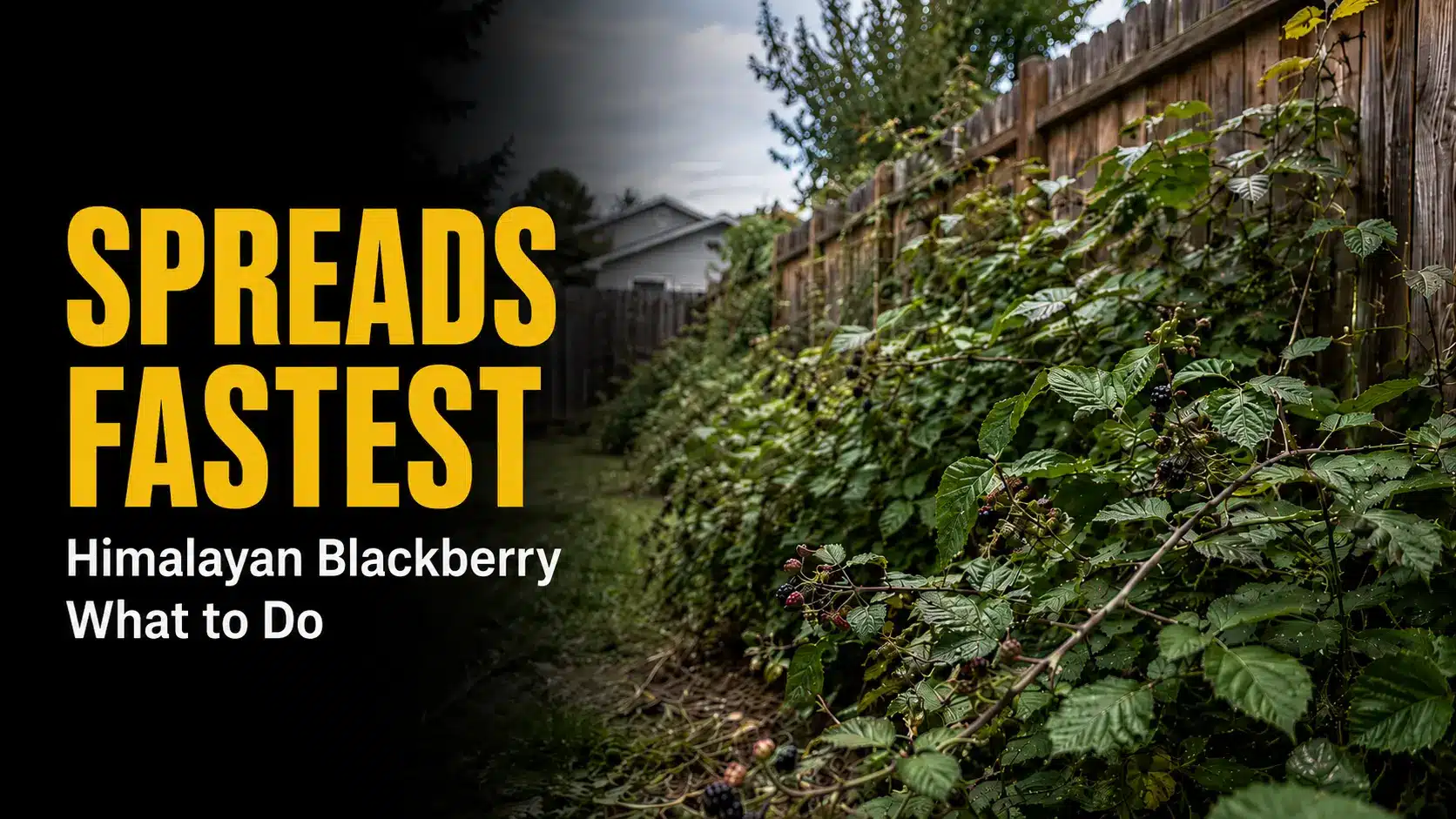
We measured a patch in Tualatin two summers ago at the start of June. By the time we came back in early August for a scheduled job, the same patch had pushed new canes more than ten feet past where we’d marked it. The homeowner hadn’t done anything wrong. That’s just what Himalayan blackberry does in an Oregon summer: it’s not slowly creeping, it’s actively racing to cover as much ground as it can before the season ends.
If you’ve noticed your blackberry patch looking bigger every time you walk past it this time of year, you’re not imagining it. Summer is the single fastest growth window for this plant, and understanding why changes what you should actually do about it right now.
Why Summer Is Himalayan Blackberry’s Growth Engine
Himalayan blackberry produces what are called primocanes first year canes that emerge from the root crown and grow explosively through spring and summer before producing flowers and fruit the following year. According to U.S. Forest Service research, these canes can grow as long as seven meters, roughly twenty-three feet – in a single season on moist, open ground. That’s not seven feet. That’s seven meters, in one growing season, from a single cane.
That growth isn’t spread evenly across the year. It’s concentrated almost entirely in the warm months. Oregon State University Extension horticulturist Brooke Edmunds has noted that a single plant can grow into a six-square-yard thicket in less than two years and the bulk of that expansion happens during spring and summer when growing conditions are at their best. Summer in the Willamette Valley gives blackberry exactly what it wants: long daylight hours, warm soil, and just enough residual moisture from spring rains to fuel rapid cane extension before things dry out in August.
How Fast Can a Patch Actually Spread in One Summer
The numbers here surprise most homeowners. A single Himalayan blackberry stem cutting has been documented forming a thicket five meters in diameter within two years. Established plants develop root-rhizome systems extending nearly ten meters about thirty-three feet and reaching as deep as ninety centimeters underground. None of that growth pauses for a summer break. If anything, summer is when the underground expansion is busiest, because the plant is using the season’s energy production to extend its root system outward in every direction at once.
Above ground, the visible part of this process is the cane tips. As primocanes extend, the growing tip will bend down and root itself wherever it touches soil, a process called tip-rooting. Each new tip-root becomes an independent point of growth with its own developing root crown. A patch that looks like one continuous thicket from the outside is often dozens of these self-sufficient root points all connected by canes, each one capable of surviving and regrowing even if the original parent plant is removed.
This is also why mowing or weed-whacking a summer patch rarely solves anything. UC IPM research notes that mowing blackberry late in the growing season can actually spread seeds further, and repeated mowing throughout the season is needed to achieve even short-term canopy reduction. A single summer mow knocks back the visible canes for a few weeks at most while the root system underneath keeps expanding undisturbed.
The Bird Nesting Complication You Can’t Ignore in Summer
Beyond the growth rate itself, summer creates a legal and ecological complication that doesn’t exist the rest of the year. Himalayan blackberry thickets are prime nesting habitat for dozens of bird species, and many of those species are actively nesting from spring through mid-summer.
The Clackamas Soil and Water Conservation District specifically advises against major blackberry control work during spring and summer for this reason, noting that birds and small mammals use the thorny brush to protect their young during these months, and that disturbing the thicket during this period can do more ecological harm than good. Beyond the ecological concern, destroying an active nest is a violation of the federal Migratory Bird Treaty Act regardless of whether the nest happens to be sitting in an invasive plant on private property.
This puts summer in an odd position. It’s the season when the problem is growing the fastest and the most visually obvious, but it’s also the season when large-scale clearing carries the most risk if active nests are present. That combination is exactly why fall ends up being the better window for full removal the growth has to be addressed eventually, but timing the major work for after nesting season avoids the conflict entirely.
What Summer Growth Looks Like by the Numbers
| Growth Factor | What the Research Shows |
| Single-season cane length | Up to 7 meters (about 23 feet) on moist, open ground |
| Thicket formation from one cutting | 5-meter diameter thicket within 2 years |
| Full patch expansion | Six-square-yard thicket in under 2 years from one plant |
| Root-rhizome extension | Up to 10 meters laterally, 90 cm deep |
| Tip-rooting | New independent root crown forms wherever a cane tip touches soil |
| Mowing effectiveness | Short-term canopy reduction only; can spread seed late in season |
What You Can Actually Do About It Right Now
You can’t stop summer growth entirely, and trying to fully remove a large patch right now isn’t the right move for the reasons above. But there are things worth doing during the growing season that genuinely help, short of a full removal job.
Spot-cutting new tip-roots before they fully establish is one of the most effective things a homeowner can do during summer. If you catch a cane tip that’s just started rooting into the ground usually visible as a small new cluster of leaves where a long cane has bent down and touched soil cutting it free before it develops its own crown stops that expansion point from becoming permanent. This is light, manageable work that doesn’t require disturbing the main thicket where nests might be present.
If you have a smaller, isolated patch with no visible nesting activity, summer foliage application of herbicide is actually noted by researchers as more effective for certain products than other timing windows though this needs to be weighed against the broader fall-timing advantage for root translocation that applies to most properties. Our guide on the best time to remove blackberry in Oregon breaks down the full seasonal picture and why fall still wins for most situations.
The most useful thing most homeowners can do in summer is simple monitoring. Walk the edges of the patch every couple of weeks and note how far the canes have extended. This tells you the real scope of the problem heading into fall, when full removal becomes both safer and more effective, and it gives you accurate information to share with a crew when you’re ready to schedule the work.
Why Waiting Until Fall Doesn’t Mean Doing Nothing
A lot of homeowners hear that fall is the better removal window and conclude there’s no point doing anything until then. That’s a mistake. The patch you have in June is smaller than the patch you’ll have in September if nothing happens between now and then. Every week of unchecked summer growth means more canes, more tip-roots, more square footage, and a bigger job when fall arrives.
We cleared a property in West Linn last October where the homeowner had called us in June for an estimate, decided to wait until fall per our recommendation, but didn’t do any of the light maintenance we’d suggested in the meantime. The patch had roughly doubled in coverage by the time we started the job. The work still got done properly, but it took two additional crew-hours and a second debris haul that wouldn’t have been necessary if the summer tip-rooting had been kept in check.
Scheduling your fall removal now, while the patch is still smaller, also means you’re not competing for a calendar slot once everyone else notices their own summer growth and starts calling in September. If you want a clear sense of what your property’s job will involve, get a free estimate now and we’ll tell you exactly what the timeline should look like.
Get Your Free Estimate
Summer is the wrong season to fully clear an established blackberry patch, but it’s the right time to get ahead of the problem before fall. Billy Goat Property Services has been managing Himalayan blackberry across the Portland tri-county area for 18 years. We’ll walk your property, tell you what’s actually happening underground, and put together a removal plan timed for when it’ll actually work. Call 503-783-4747 or get your free estimate here.
Common Questions About Blackberry Growth in Summer
Why does my blackberry patch look bigger every week in summer?
Because it is. Himalayan blackberry produces first-year canes called primocanes that can grow up to seven meters in a single growing season on moist, open ground, according to U.S. Forest Service research. Summer provides the warmth and daylight hours that drive this growth, and it’s concentrated almost entirely in spring and summer rather than spread evenly across the year.
Should I cut my blackberry back in summer to stop it from spreading?
Light, targeted work is fine cutting individual cane tips before they tip-root into the soil is genuinely useful. But cutting back the main thicket isn’t recommended in summer if there’s any chance of active bird nests inside it, which is common given how blackberry thickets are used as nesting habitat. Full removal is also less effective in summer because herbicide and root work both perform better once the plant starts moving energy underground in fall.
Is it illegal to clear blackberry in the summer in Oregon?
Clearing the plant itself isn’t illegal, but disturbing or destroying an active bird nest is a violation of the federal Migratory Bird Treaty Act, and Himalayan blackberry thickets are common nesting sites from spring through mid-summer. Conservation districts in the Portland area specifically recommend avoiding major blackberry control work during this window for this reason.
Does mowing blackberry in summer actually help?
It provides short term canopy reduction at best. Research from UC’s Integrated Pest Management program notes that mowing needs to be repeated throughout the growing season to have any real effect, and mowing late in the season can spread seeds further rather than controlling them. The root system underneath is untouched by mowing and continues expanding regardless.
When should I actually schedule blackberry removal if summer isn’t the right time?
Fall specifically September through November is the best overall window for most Portland properties. Our full breakdown of blackberry removal timing in Oregon covers why fall works best for both herbicide effectiveness and physical root removal. Scheduling an estimate now, during summer, still makes sense so you’re not waiting in line once fall arrives and everyone else has the same idea.
Every week this summer that the patch goes unchecked is a bigger job come fall. Call 503-783-4747 or get your free estimate from Billy Goat Property Services and let’s get ahead of it before it gets ahead of you.