
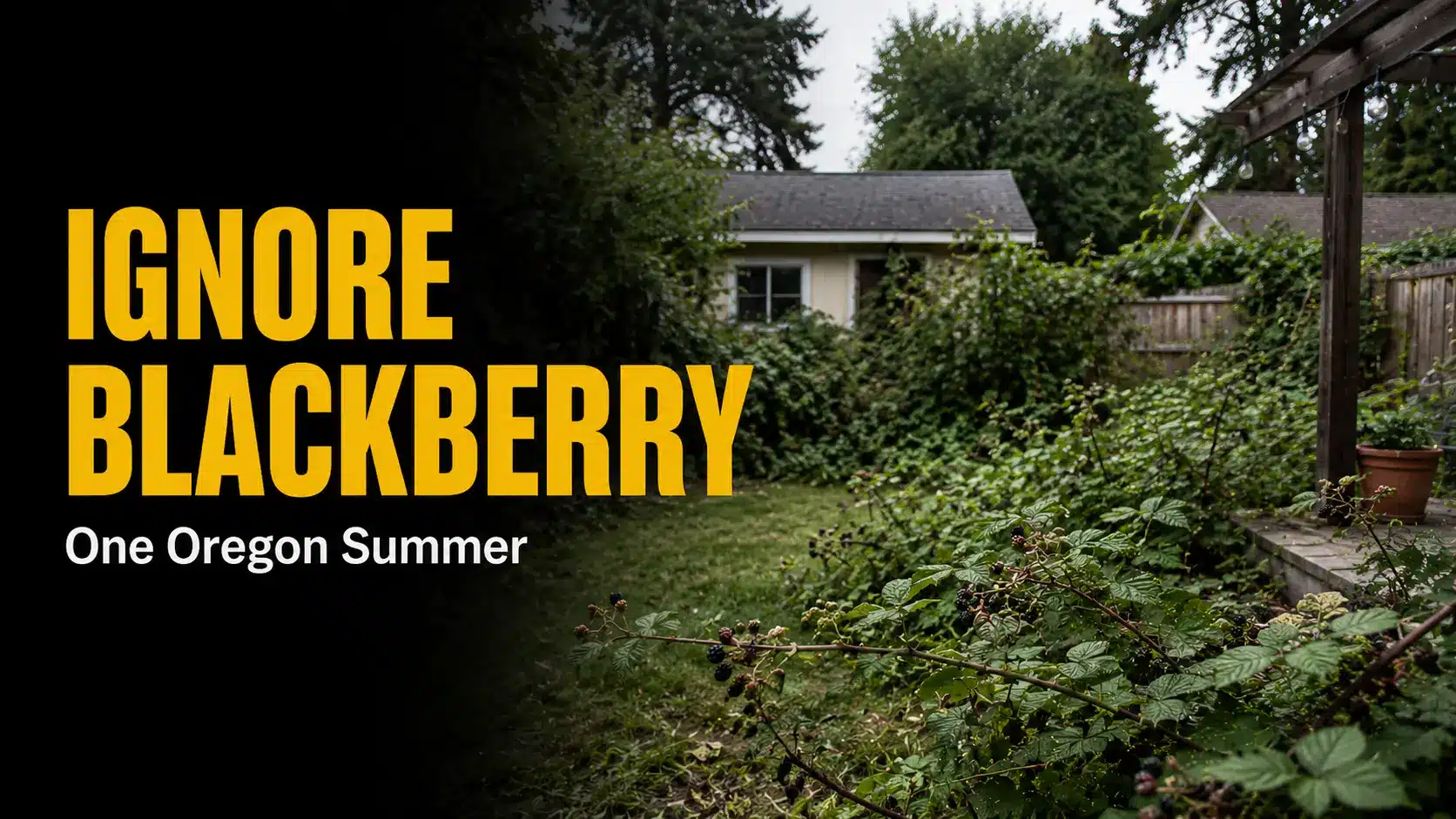
A homeowner in Gresham called us in late September a couple of years back. He’d noticed a patch in the back corner of his lot in April, told himself he’d deal with it in summer, and then hadn’t. By the time he called, the patch had crossed twelve feet of open yard, canes had woven themselves through the chain link fence into the neighbor’s property, and three separate tip-rooted crowns had established themselves well away from the original plant. What would have been a manageable spring job had become a two-crew fall project.
This isn’t a worst-case story. It’s a typical one. Himalayan blackberry doesn’t stay the same size while you’re deciding what to do about it. One Oregon summer is a long time for this plant. Here’s what actually happens to a property between June and September when blackberry is left alone.
June: The Growth Window Opens
By early June, Himalayan blackberry is already running. The plant’s primocanes, the long, arching first-year canes that do most of the spreading, emerge from the root crown in spring and hit peak growth rate once Portland temperatures settle above 60 degrees consistently. U.S. Forest Service research documents canes reaching seven meters roughly twenty three feet in a single season on moist, open ground. That growth doesn’t happen evenly across twelve months. The bulk of it happens between June and August, when Oregon’s long daylight hours and warm soil give the plant exactly the conditions it needs.
In June, a patch that looked like a manageable problem in April starts to look different. Canes that were knee-high are now shoulder height. The footprint of the patch hasn’t expanded dramatically yet, but the above-ground mass has increased significantly, and underground the root system has been extending outward since the soil warmed in March. What you’re seeing above ground in June is already behind what’s happening below it.
The other thing that happens in June is flowering. Himalayan blackberry blooms from late May through July in the Portland area. Each flower is a future berry, and each berry contains multiple seeds. A single cane can produce hundreds of berries. The seeds in those berries will be distributed across the neighborhood by birds and other wildlife through summer and fall, seeding the next generation of patches in bare soil, fence lines, and creek corridors across your property and beyond.
July: Tip-Rooting Starts Claiming New Ground
July is when the spreading becomes structural. As primocanes extend outward and their tips bend toward the ground, they make contact with soil and begin tip rooting. This is the process that turns one blackberry plant into many. Each cane tip that roots into the ground develops its own independent root crown, a woody, knuckle-like structure below the soil surface from which new canes will emerge next spring regardless of what happens to the original plant.
A single established blackberry plant can produce multiple primocanes in one season, each capable of tip rooting at the end of its arc. By mid July, a patch that had one clear origin point in spring may already have three or four satellite crowns establishing themselves several feet away from the main plant. These satellites aren’t visible yet they’re just cane tips that have bent into contact with soil. But they’re already building root mass underground.
This tip-rooting behavior is one of the primary reasons that blackberry spreading speed is so difficult to assess from above ground. Washington County’s Soil and Water Conservation District describes Himalayan blackberry as the most widespread and disruptive of all noxious weeds in western Oregon, noting that it reproduces aggressively by both canes and seeds simultaneously. What looks like a stationary patch from a distance is actively colonizing new ground in July at multiple points at once.
This is also the month when fence lines become a real problem. Canes reaching for open ground don’t stop at wooden boards or chain link. They push through, weave into the structure, and begin tip-rooting on the other side. By the end of July, a patch that started on your property can have live, rooting cane tips establishing themselves on a neighbor’s side of a shared fence – a fact that creates both a practical problem and a potential neighbor dispute that didn’t exist three months earlier.
What One Summer Actually Looks Like by the Numbers
| Timeframe | What’s Happening |
| Early June | Primocanes hit peak growth rate; above-ground mass increasing rapidly; flowering begins |
| Late June | Canes reaching 6-10 feet; root system extending underground in all directions; seeds forming |
| Mid July | Tip rooting begins creating satellite root crowns away from the main plant |
| Late July | Canes reaching fence lines; tip-rooting through and beyond boundaries; satellite crowns establishing |
| August | Berries ripening; seed dispersal by birds begins seeding new areas; cane tips reaching 15-20+ feet from origin |
| September | Growth slows as temperatures drop; tip-rooted crowns now established; multiple new origin points exist |
| By fall | What was one patch is now multiple independent plants; job cost has increased significantly |
August: Seeds Are Spreading Your Problem Across the Neighborhood
August is berry season in Oregon, and it’s also when Himalayan blackberry becomes a neighborhood-scale problem rather than just a backyard one. Ripe berries are eaten by birds, raccoons, deer, and other wildlife, all of which distribute seeds in their droppings across a wide area. A single cane can carry hundreds of berries. A mature thicket can produce thousands.
OSU Extension horticulturist Brooke Edmunds has noted that blackberry has tremendous dispersal potential birds and animals feed on the berries and spread seeds over long distances, and even banana slugs contribute by eating berries and dispersing seeds. OSU Extension research confirms that a single plant can grow into a six-square yard thicket in less than two years. The seeds distributed in August are the patches that will appear in your fence line, your garden beds, and your neighbor’s yard in the next season and the one after that.
The other August problem is what the canes have reached by now. On open, moist ground, primocanes can extend twenty feet or more from the root crown by late summer. In a typical Portland backyard, that means a patch that started in one corner can have canes reaching across a significant portion of the usable yard, tip-rooted at multiple points, and beginning to shade out and smother whatever was growing underneath.
September: The Bill Has Come Due
By the time most homeowners decide they absolutely have to deal with the blackberry, the summer is essentially over and the damage is done. The patch that existed in April is unrecognizable. What may have been a single-origin infestation is now a network of independent root crowns spread across a much larger area. The canes have woven into fences, overhanging structures, and neighboring vegetation. The debris volume of what needs to be cleared has multiplied.
We walked a property in Milwaukie last fall where the homeowner had done exactly this noticed a manageable patch in spring, waited too long, and called us in October. What she described as a single patch in the corner had become four separate actively growing crowns, two of which were on the other side of her fence line and technically her neighbor’s problem to manage. The original job estimate based on her April description would have been around $600. The actual job came in at $1,400. One summer of waiting cost her $800 and a conversation she didn’t want to have with her neighbor.
This is the consistent pattern we see. The job that gets ignored through one Oregon summer doesn’t cost the same in fall as it would have in spring. It costs sometimes twice as much because there’s more coverage, more root crowns, more debris, and often more complicated access once the canes have grown into fences or structures.
What One Summer of Ignoring It Actually Costs You
The direct cost is the most obvious part. A spring job for a contained patch might run $400-600. The same patch ignored through summer, with tip-rooted satellites and doubled coverage, realistically runs $800-1,400 by fall. For larger properties or patches that were already significant in spring, the multiplier applies to a bigger starting number and the gap is even wider.
The less obvious cost is what the summer’s growth has made permanently harder to reverse. Root crowns that have been in the ground for one additional growing season are bigger, deeper, and more established than they were in spring. Each additional season of growth adds to the difficulty and cost of proper extraction. A patch ignored for two consecutive summers doesn’t cost twice as much to address as a patch that was caught in year one it often costs three to four times as much, because the root systems are now dense, deep, and fully interconnected across a much larger area.
There’s also the structural damage question. Canes that have grown into a wooden fence through summer add physical load to the structure and begin working the wood apart where they’ve rooted in. Canes growing under deck boards or into siding create pathways for moisture. The Mother Earth Gardener documented blackberry vines reaching four inches in diameter growing under siding, into electrical wires, and cutting off plumbing in extreme cases. That level of damage is years away from a single summer’s growth, but the canes reaching your fence boards in August are the beginning of that process.
What to Do If You’ve Already Missed the Spring Window
If you’re reading this in summer or fall and the patch is already bigger than you wanted it to be, the answer is not to wait another season. Fall is actually the best window for effective blackberry removal not because the problem is smaller, but because herbicide applied in fall is significantly more effective as the plant moves energy into its root system for winter.
What you can do right now, even in peak summer, is limit further expansion. Cut any cane tips you can see bending toward the soil before they complete the tip-rooting process. This won’t address the existing root crowns but it slows the creation of new satellite plants. Focus on the outermost edges of the patch rather than the center stopping the perimeter from expanding further is more valuable than cutting the interior mass that’s already established.
The most useful thing you can do in summer is schedule a fall estimate rather than attempting a full DIY removal in difficult heat and dry soil conditions. Fall removal with proper root crown extraction and coordinated herbicide treatment is more effective and more permanent than summer clearing, even if the summer patch is larger than the spring one was. Our full breakdown of blackberry removal timing in Oregon covers exactly why the fall window works and what to expect from the process.
Get Your Free Estimate
Whether you caught it early or you’re looking at a full summer’s worth of growth, the right move is to get a clear assessment of what you’re actually dealing with before the next season makes it worse. Billy Goat Property Services has been clearing Himalayan blackberry across the Portland tri-county area for 18 years. We’ll walk the property, tell you exactly what the job involves now versus what it would have been, and put together a removal plan that fits the timing. Call 503-783-4747 or get your free estimate here.
Common Questions About Blackberry Spreading Speed in Oregon
How much can blackberry spread in one summer in Oregon?
Significantly. U.S. Forest Service research documents individual canes reaching seven meters about twenty-three feet in a single growing season on moist, open ground. Beyond the cane length, the plant simultaneously tip-roots at multiple points and distributes seeds through berries eaten by birds and wildlife. A patch that looks contained in spring can have multiple new independent root crowns established several feet beyond the original plant by September.
Does blackberry spread underground or above ground?
Both at the same time. Above ground, primocanes extend outward and tip-root wherever they touch soil, creating new independent plants. Underground, rhizomes extend laterally from the root crown research documents, reaching up to ten meters in length. A single summer adds meaningful underground extension in every direction around an established plant, which is why jobs that wait a season are larger and more expensive than jobs that don’t.
Will blackberry damage my fence if I ignore it through summer?
Over time, yes. Canes that weave into fence boards add physical load and create moisture pathways where they’ve rooted against the wood. One summer of contact with a wooden fence won’t destroy it, but canes left in contact with structures across multiple seasons cause increasingly difficult-to-reverse damage. The practical concern in a single summer is that canes will tip-root through or beyond the fence, creating establishment points on the neighbor’s side that become their problem to manage and your conversation to initiate.
Is fall too late to remove blackberry after an Oregon summer?
Fall is actually the best overall window for blackberry removal, regardless of how much growth happened in summer. Herbicide applied in fall is more effective because the plant is moving energy into its roots, and soil conditions improve for root extraction once the first rains arrive in September and October. The patch will be larger than it was in spring, which means the job is bigger and costs more but fall removal done properly is more permanent than spring removal done quickly. Our blackberry removal timing guide covers exactly what makes fall the right window.
How much more does blackberry removal cost in fall vs spring?
In our experience across the Portland tri-county area, a patch ignored through one Oregon summer typically costs 50-100 percent more to remove in fall than the same job would have cost in spring. The increase comes from greater coverage, additional satellite root crowns from tip-rooting, more debris volume, and sometimes more complicated access once canes have grown into fences or structures. Our cost guide for blackberry removal in Portland covers the full pricing picture by job size.
Every week the patch sits is a larger job and a higher bill. Call 503-783-4747 or get your free estimate from Billy Goat Property Services and find out what you’re actually dealing with before another season passes.