
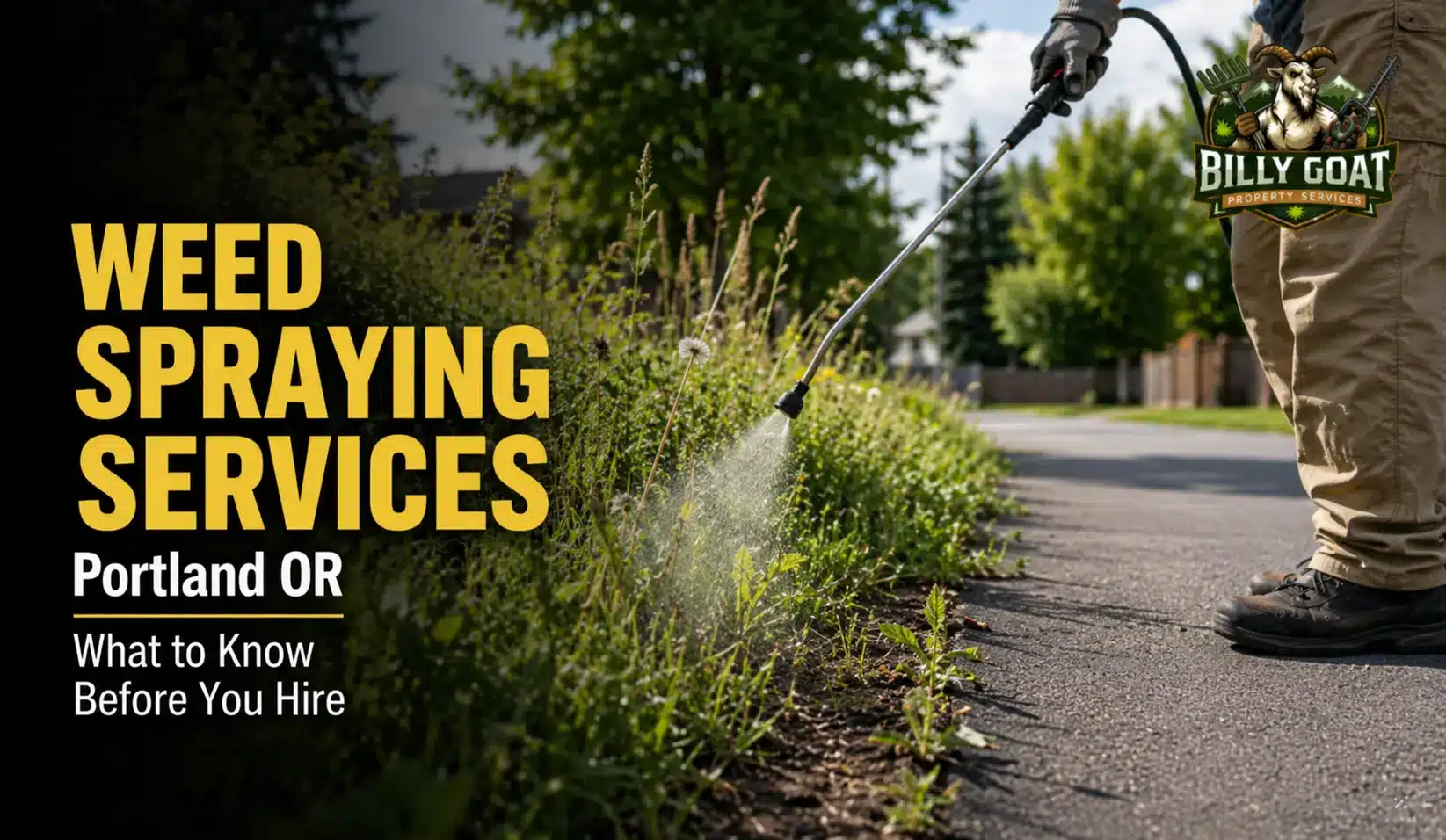
We got a call last summer from a homeowner in Southwest Portland who’d been spraying Roundup on a blackberry and thistle mix in his back slope for two seasons straight. The weeds kept coming back, the slope was getting worse, and he couldn’t figure out why. When we came out, the problem was obvious: he was applying the right product at the wrong time, with the wrong concentration, in conditions that guaranteed most of it wasn’t reaching the root system. He’d spent two years and probably $300 on a product doing what a single licensed application would have fixed the first time.
Weed spraying in Portland sounds straightforward. It isn’t. This guide covers what professional herbicide application actually involves, what Oregon law requires of anyone spraying on your property, and what to ask before you hire anyone to do it.
Why Weed Spraying Is More Complicated Than It Looks
The weeds that give Portland homeowners the most trouble Himalayan blackberry, English ivy, Canada thistle, Japanese knotweed, and morning glory don’t respond the same way to the same products. Each has a different root structure, a different growth cycle, and a different window when herbicide is most effective. Apply a systemic herbicide to blackberry in July and most of it evaporates before reaching the root crown. Apply the same product in October when the plant is moving energy underground, and the result is completely different.
Concentration matters just as much as timing. Store-bought herbicides are typically diluted well below the thresholds needed for established invasive plants with deep root systems. Oregon State University Extension consistently notes that controlling established invasive weeds like Himalayan blackberry requires persistence, correct product selection, and proper timing, the kind of knowledge that takes more than reading a label to get right.
There’s also the question of selective vs. non-selective herbicides. A non-selective product kills everything it touches. A selective product targets specific plant types while leaving others. Getting this wrong on a slope near a garden, a stream, or a neighbor’s fence line doesn’t just mean dead weeds it can mean dead landscaping you wanted to keep, or liability for damage to adjacent property.
What Oregon Law Requires for Weed Spraying on Your Property
If you hire someone to apply any pesticide including herbicide on your property in Oregon, that person must be licensed by the Oregon Department of Agriculture. This isn’t optional. Under Oregon Revised Statute 634, any business applying pesticides on the land or property of others must hold a Commercial Pesticide Operator License, and the person doing the application must hold a Commercial Pesticide Applicator License. These are separate credentials, both required.
A Commercial Pesticide Applicator License requires passing state exams, working under a licensed operator, and completing continuing education every five years. The licensing categories must also match the type of work being done a license for agricultural applications doesn’t automatically cover residential landscape or vegetation management work.
This matters for you as the property owner because if someone sprays your property without the proper license, any resulting damage – to your plants, a neighbor’s property, nearby water, or native vegetation – can create liability that traces back to you for allowing unlicensed work. Always ask for license numbers before anyone applies herbicide on your property. The ODA maintains a searchable online database where you can verify credentials.
Portland-Specific Considerations: Water and Neighbors
Portland’s residential landscape creates a specific set of complications for herbicide application that don’t exist in drier climates. The city sits on a dense network of creek corridors, stormwater drains, and waterways that connect directly to the Willamette. Chemical drift or runoff from a slope treatment can reach those waterways faster than most homeowners expect, particularly on properties along Johnson Creek, Fanno Creek, Tryon Creek, and their tributaries.
Oregon’s DEQ regulates pesticide applications near water under the Clean Water Act’s NPDES permitting framework. Applications in, over, or near surface water require additional permits and restrictions beyond the standard applicator license. A licensed professional knows these rules and applies product accordingly – adjusting concentration, application method, and buffer distance based on site conditions. Someone without that training simply doesn’t know what they don’t know.
Neighbor proximity is the other Portland-specific issue. On a typical residential lot, the fence line is often ten feet from a neighbor’s garden, raised beds, or mature landscaping. Herbicide drift on a windy day, or soil absorption from a heavy application near a property line, can damage plants on the other side. Oregon law prohibits actions that damage neighboring property, and the person who contracted the spray work carries responsibility. Licensed applicators carry insurance specifically for this reason. Unlicensed ones don’t.
We got a call two summers ago from a homeowner in Lake Oswego whose contractor had sprayed blackberry along a shared fence line on a warm afternoon with a light breeze. Three of the neighbor’s established rose bushes were dead within a week. The spray had drifted six feet. The homeowner who hired the crew – not the crew itself – ended up covering the cost of replacement because the applicator had no license and no insurance. A licensed applicator would have flagged the wind conditions and rescheduled. That’s the practical difference.
What Professional Weed Spraying Actually Involves
A proper weed spraying job isn’t showing up with a backpack sprayer and walking the yard. It starts with identifying exactly what you’re dealing with. Different weed species, different growth stages, and different site conditions all change the prescription which product, what concentration, what application method, and what time of year produces the best result.
For invasive vegetation like blackberry and knotweed, herbicide is most effective as part of a combined approach. Physical clearing, cutting the canes back or removing root crowns reduces the biomass the herbicide has to work through and gets it closer to the root system. A fall application on freshly cut vegetation, when the plant is pulling energy into its roots, is significantly more effective than spraying green canes in summer. One without the other produces mediocre results.
For general vegetation management – thistle, morning glory, bindweed, and similar spreading weeds a properly timed pre-emergent application in early spring combined with a post emergent follow-up can keep a property clean through the season without repeated treatments. The timing window for pre-emergents is narrow, typically late February through mid March in the Portland area before soil temperatures trigger germination. Missing that window means you’re treating weeds that are already established, which requires more product and more visits. Our weed spraying service covers both approaches depending on what the site requires.
Weed Spraying at a Glance: What to Ask Before You Hire
| Question to Ask | Why It Matters |
| Are you licensed by the Oregon Department of Agriculture? | Required by law for any commercial herbicide application on your property |
| What license category covers this type of work? | License categories must match the job – not all licenses cover residential vegetation management |
| What product are you applying and why? | A professional can explain product selection; someone guessing can’t |
| What’s the timing rationale for this application? | Timing determines effectiveness – wrong season means the job won’t hold |
| Do you carry liability insurance for herbicide damage? | Unlicensed applicators often don’t; if something goes wrong, you’re exposed |
| What happens if it doesn’t work – do you come back? | Invasive weeds often need follow-up; know upfront whether that’s included |
| Are there any waterways or drainage features on or near the property? | Changes application method, product selection, and buffer requirements |
DIY Spraying vs. Hiring a Licensed Applicator
DIY herbicide application is legal on your own property in Oregon. You don’t need a license to spray your own weeds. The question is whether it’s effective for what you’re dealing with.
For common lawn weeds – dandelions, clover, crabgrass in a manageable lawn area – store-bought products applied at the right time of year do the job fine. The label instructions are sufficient for straightforward situations and the stakes are low if you get the timing slightly wrong.
DIY stops making practical sense for established invasive plants, large areas, slopes, or anything near a property boundary or waterway. Himalayan blackberry with a root crown two feet underground doesn’t respond to consumer-grade glyphosate the way a dandelion does. Knotweed on a creek bank requires a site assessment, specific application methods, and usually multiple seasons of treatment to get meaningful control. Attempting those jobs without the right product, concentration, and timing knowledge produces frustration, not results.
The Southwest Portland homeowner we mentioned at the start had spent two years and real money doing it himself. The cost of a licensed application the first time would have been less than what he spent on a product that didn’t work. Read our breakdown of when DIY makes sense and when it doesn’t for a fuller picture.
What Billy Goat Does for Weed Spraying in Portland
Most weed spraying companies are licensed applicators. They show up, spray, and leave. What they don’t do is the physical work that makes the spray effective and for established invasive plants like blackberry, knotweed, and English ivy, that’s exactly where most spray-only programs fall short. You’re putting herbicide on a dense canopy of canes and leaves and hoping enough of it reaches the root system to matter. It usually doesn’t.
Billy Goat works the other way around. We handle the physical clearing first – cutting canes, extracting root crowns, reducing the biomass down to a point where a herbicide application can actually reach the root system directly. Then we coordinate with licensed ODA-certified applicators for the chemical treatment, timed for fall when the plant is actively pulling energy underground. Physical clearing without chemical follow-up misses the remaining root mass. Chemical treatment without physical clearing means the herbicide is fighting through too much plant material to be effective. Doing both in sequence, in the right order, at the right time of year is what produces results that hold.
It’s a different model than hiring a spray company and a clearing crew separately, and it means you’re not managing two contractors or hoping their timing lines up. We coordinate the whole job. See our weed spraying service for more on how we approach it, or our full list of property services to see everything we handle across the tri-county area.
Get Your Free Estimate
If weeds are taking over part of your Portland property and you’ve been going in circles with DIY treatments, the right move is to get a proper assessment before another growing season starts. Billy Goat Property Services has been managing vegetation across the Portland metro for 18 years. Call 503-783-4747 or get your free estimate here.
Common Questions About Weed Spraying in Portland
Does someone need a license to spray weeds on my property in Oregon?
Yes. Any business applying pesticides including herbicide on your property must hold a Commercial Pesticide Operator License from the Oregon Department of Agriculture. The individual doing the application must hold a separate Commercial Pesticide Applicator License. You can verify credentials through ODA’s online license lookup before anyone starts work.
Why isn’t my DIY herbicide working on blackberry?
Usually one of three reasons: wrong timing, wrong concentration, or wrong product for the root depth. Himalayan blackberry stores energy in underground root crowns up to two feet deep. Consumer-grade herbicides at label concentrations rarely reach those crowns effectively. Fall application – when the plant is actively pulling energy into its roots – is significantly more effective than summer treatment. Our guide on why blackberry keeps coming back covers the root biology in detail.
Can herbicide from my property drift onto my neighbor’s yard?
Yes, and Oregon law holds you responsible for damage to neighboring property caused by the herbicide application you contracted. Drift risk is highest on windy days and with certain application methods. A licensed applicator assesses wind conditions, adjusts equipment and concentration, and carries liability insurance specifically for this risk. Hiring unlicensed applicators or DIY-ing near a property boundary creates genuine legal exposure if something goes wrong next door.
Is it safe to spray near Portland’s creeks and waterways?
It requires specific knowledge and in some cases additional permits. Oregon DEQ regulates pesticide applications near surface water, and some herbicides are prohibited near fish-bearing waterways regardless of application method. A licensed applicator knows the product restrictions, required buffer distances, and application methods that are both legal and effective near water features. Properties along Johnson Creek, Fanno Creek, and similar corridors need extra care on this front.
How much does professional weed spraying cost in Portland?
It varies based on the size of the area, the weed species, site access, and whether physical clearing is included before the herbicide application. A single spot treatment for a manageable lawn weed situation is different from a multi-visit program for established blackberry on a slope. The best way to get an accurate number is a free on-site estimate – we can tell you exactly what the job involves and what it costs before anything is scheduled.
How is weed spraying different from blackberry removal?
Blackberry removal is primarily physical – cutting canes, extracting root crowns, hauling debris. Weed spraying is chemical – applying herbicide to kill the plant’s root system from within. For established blackberry, the most effective approach combines both: physical clearing first to reduce biomass, then a timed herbicide application to finish the root system. Our blackberry removal service covers both components and we coordinate the chemical treatment with licensed applicators.
Two seasons of DIY spraying that doesn’t work costs more in time and product than one proper job done right. Call 503-783-4747 or get your free estimate from Billy Goat Property Services and let’s figure out what your property actually needs.