
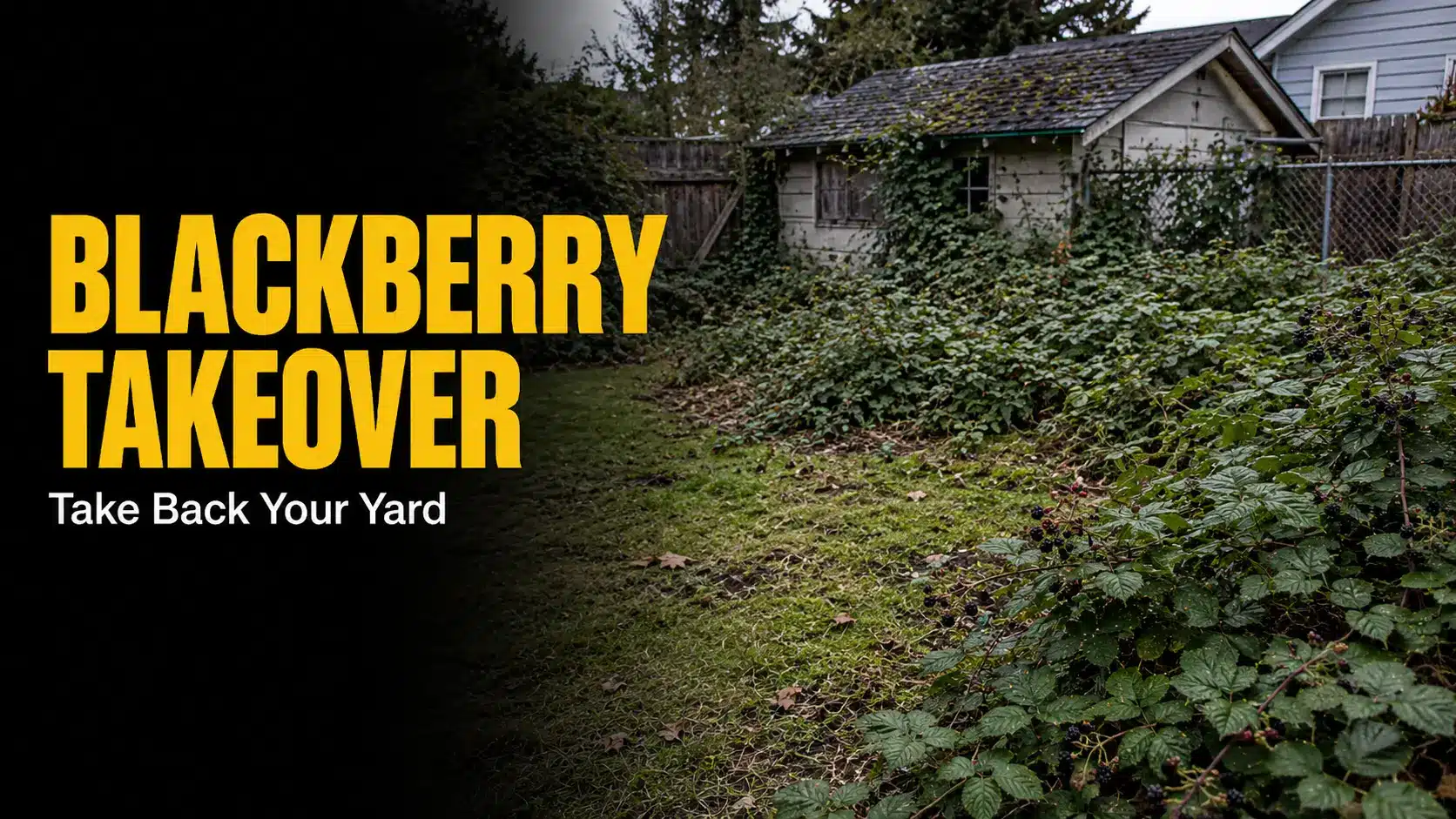
Most homeowners don’t lose their backyard to blackberry all at once. It starts in a corner, or along the fence line, or in the strip behind the shed that nobody walks through very often. By the time it’s impossible to ignore, the patch is fifteen feet across, the canes are chest-high, and the idea of dealing with it feels overwhelming enough that it’s easier to just close the back door and not look.
We’ve walked hundreds of Portland-area backyards that are in exactly this situation. The good news is that no matter how far gone it looks, there’s a logical sequence for reclaiming it. This is that sequence what to assess, what to do first, what order actually works, and where a professional crew changes the math.
First, Understand What You’re Actually Dealing With
Before you do anything, spend ten minutes walking the edges of the problem. Not to cut it back yet just to understand it. How far has the patch extended? Are there canes that have tip-rooted into new areas beyond the main mass? Is the growth coming partly from a neighbor’s property, from a slope below the fence, or from multiple separate origin points?
The reason this matters is that the plan for a single established patch in a flat backyard is different from a backyard where blackberry has spread in from three directions and rooted into multiple points across the yard. Treating a multi-origin infestation like a single-patch job means you clear one area and watch the others keep spreading while you’re not looking.
It also helps to know roughly how long the growth has been there. A patch that arrived this season has shallow root crowns that are genuinely manageable with hand tools. A patch that’s been building for three or four years has deep, woody root crowns that require different equipment and different expectations about what one round of work will accomplish. Oregon State University Extension is clear that established blackberry control is a multi-season effort for exactly this reason – the first visit is rarely the last one.
What to Do First: Cut the Canopy Back
The first step in any overgrown blackberry job is reducing the above-ground canopy. You can’t do root work you can’t see or reach, and you can’t assess the full extent of the underground problem until the cane mass on top is out of the way. This is also the physically hardest part of the job long, thorny canes tangled into each other, often woven through fence boards or growing into neighboring vegetation.
For DIY work on a manageable patch, heavy loppers and thick leather gloves are the minimum. A bow saw or reciprocating saw with a pruning blade helps for thicker canes at the base. Cut everything as close to the ground as you can reach and pile it as you go – don’t let cut canes pile up across uncut sections or you’ll be fighting your own debris for the rest of the job. Work from the outside edges inward so you always have a clear exit.
For larger patches anything that’s significantly taller than you, covering more than a few hundred square feet, or on a slope mechanical brush cutters or a commercial mower with a mulching deck is what it actually takes to get through the canopy phase in a reasonable timeframe. Most homeowners don’t own that equipment, which is the practical point where a crew changes the equation.
The Step Most People Skip: Getting the Roots Out
Cutting the canopy is satisfying because you can see the result immediately. But it’s also the step that fools the most people into thinking the job is done. Himalayan blackberry stores its energy in underground root crowns that can sit eighteen to twenty four inches below the soil surface and extend outward as rhizomes for up to ten feet in every direction. Research from the U.S. Forest Service documents root systems reaching ninety centimeters deep and ten meters across. Cutting the canes above ground leaves all of that untouched.
Within three to six weeks of a surface cutback, the root crowns push up new primocanes. By the end of a Portland summer, a patch you cleared in May looks nearly as bad as it did before you started. This is the most common reason people feel like blackberry is impossible to kill, but you have to get the roots, not just the canes.
Root crown extraction requires digging. For accessible, flat ground where the crowns are shallower, a mattock or heavy grubbing hoe works well. You’re looking for the woody, knuckle-like structures at the base of each cane cluster, usually two to six inches below the soil surface for younger growth and deeper for older patches. Each crown needs to come out as completely as possible. Leaving fragments behind means regrowth, just slower.
We cleared a job in Sherwood last spring where a homeowner had cut the same backyard patch back twice in the previous two years. Both times it came back fully by fall. When we dug in, the root crowns in that corner had been growing undisturbed for at least four seasons; some of them were the size of a large fist and were sitting fourteen inches down. Three hours of proper crown extraction put an end to what two rounds of surface cutting hadn’t touched.
The Backyard Reclamation Sequence
| Step | What It Involves | DIY or Pro? |
| 1. Assess the patch | Walk edges, identify origin points, check for tip-rooting, estimate root age | DIY |
| 2. Cut the canopy | Remove all above-ground canes as close to soil as possible, haul debris | DIY for small areas; Pro for large, tall, or sloped patches |
| 3. Extract root crowns | Dig out woody crown structures and connected rhizomes | DIY for shallow/recent growth; Pro for established patches |
| 4. Haul all debris off-site | Canes and root mass removed from property – don’t compost or pile | Pro recommended – volume is larger than expected |
| 5. Treat remaining root fragments (fall) | Herbicide application timed for fall when plants pull energy underground | Licensed applicator required for chemical treatment |
| 6. Monitor and follow up | New cane growth from missed roots or seeds; cut or treat within 2-3 weeks | DIY manageable at this stage |
Dealing With Debris: More Than You Expect
Blackberry generates more waste than almost any other yard clearance job. A patch covering a couple hundred square feet of established growth produces a volume of thorny cane and root mass that surprises most people who haven’t dealt with it before. Wet canes are heavy. Thorny piles are dangerous to handle without protection. And unlike grass clippings or leaves, blackberry canes and roots cannot go in your yard waste bin or compost live root fragments and seeds can establish themselves from yard waste and reinfest wherever the debris ends up.
Most Portland-area yard waste services and Metro transfer stations accept blackberry debris in the general yard waste stream as long as it’s bagged or bundled. But the logistics of getting large volumes of thorny material from your backyard into bags or truck beds is its own challenge. This is the part of the job where having a crew with a dump trailer changes the math most significantly. What takes a homeowner multiple trips and an entire weekend to haul disappears in one load.
For context on debris volume and what full-service removal includes, our blackberry removal service page covers what’s included in a Billy Goat job from canopy cut to final haul-off.
What to Plant After: Giving Blackberry No Room to Return
One of the most effective things you can do after clearing a blackberry patch is replace bare soil with something else immediately. Bare ground is exactly what blackberry looks for when seeds or tip-rooted canes are looking for a new foothold. A cleared backyard left bare through the winter is an invitation for reinfestation from neighboring patches, from seeds already in the soil, or from any root fragments that survived the initial removal.
Native ground covers that establish quickly and provide dense coverage work well for this purpose sword fern, kinnikinnick, and native bunch grasses are all used in the Portland area for post-blackberry restoration. If the cleared area is intended for lawn, seeding immediately after the ground is prepared closes the bare soil window faster than waiting. The goal is simply to not leave the soil open any longer than necessary.
If the infestation was significant and you want to use fall herbicide treatment as part of the follow-up, coordinate that timing before you plant. A fall herbicide application on remaining root fragments should happen before you put down new plantings, not after. Our guide on weed spraying in Portland explains how the chemical and physical stages are best sequenced.
When the Backyard Needs a Professional Crew
Some backyards are genuinely manageable as DIY projects. A patch that’s been there one season, on flat accessible ground, covering a hundred square feet or less that’s a weekend job for someone willing to put in the work and follow up consistently through the growing season.
The calculation shifts once you’re dealing with old, deep root crowns, significant coverage, slope, limited access, debris volume you can’t realistically haul yourself, or a patch that has already beaten two previous removal attempts. At that point the equipment, the labor, and the disposal logistics are the bottleneck, not the knowledge or the willingness.
The other factor is timing. A professional crew can assess what equipment the job requires, execute the physical and root extraction work efficiently, haul everything off-site in one visit, and coordinate the licensed herbicide follow-up for fall. For most established Portland backyard blackberry situations, that approach costs less in total factoring in your time, equipment rental, multiple disposal runs, and the risk of doing it wrong and repeating the work than it looks on paper when you’re comparing quotes.
If you’re not sure which category your backyard falls into, a free on-site estimate answers that question clearly. Billy Goat Property Services has been clearing overgrown Portland backyards for 18 years. We’ll walk the property with you, tell you exactly what the job involves, and give you a clear number before anything starts. Call 503-783-4747 or get your free estimate here.
Get Your Free Estimate
An overgrown blackberry backyard isn’t a lost cause it’s a sequencing problem. Get the canopy down, get the roots out, get the debris gone, and follow up correctly in fall. Billy Goat Property Services handles every stage of that process across Portland and the tri-county area. Call 503-783-4747 or request your free estimate here.
Common Questions About Overgrown Backyard Blackberry
Where do I even start with a completely overgrown backyard?
Start by walking the edges of the patch to understand the full extent of it before you touch anything. Note where it’s coming from, how far it’s spread, and whether canes have tip-rooted into areas beyond the main mass. Then cut the canopy back to ground level – outside edges inward – before doing any root work. You can’t assess or address the root system until the above-ground growth is out of the way.
Will cutting the blackberry back make it stop growing?
Not on its own. Cutting the canes removes what’s visible but leaves the root crown system underground completely intact. Those crowns push up new canes within three to six weeks. The only way to stop regrowth is to extract the root crowns or follow up with a timed herbicide application that reaches the roots directly. Most backyards that keep growing back after repeated cutting have never had their root crowns addressed.
Can I compost blackberry canes and roots after removing them?
No. Blackberry canes can re-root from cut stems, and seeds in the root mass or on cut canes can germinate wherever the compost ends up. Everything that comes out needs to go to a yard waste facility or transfer station, not your backyard compost pile. Most Portland-area Metro facilities accept blackberry debris as bagged or bundled yard waste.
How many visits does it take to fully clear an overgrown backyard?
For most established blackberry situations, expect at least two visits one for the initial canopy cut and root extraction, and a follow-up in the same season or the following spring to address any regrowth from missed root fragments or seeds. Oregon State University Extension is clear that complete control of established blackberry takes persistence across multiple seasons for deeply rooted infestations. The first visit does the heavy lifting. Each follow-up is progressively easier.
How much does it cost to clear a blackberry-filled backyard in Portland?
Most established residential backyard jobs fall in the $600-1,200 range for cutting, root work, and full debris haul-off. Larger lots, steep slopes, difficult access, or heavily rooted patches can run $1,200-3,000 or more. The best way to get an accurate number is a free on-site estimate. Our cost guide for blackberry removal in Portland covers what drives the price up or down in detail.
What should I plant after removing blackberry from my backyard?
Native ground covers and dense low-growing plants that establish quickly are the best option. Sword fern, kinnikinnick, and native bunch grasses work well in the Portland area. The goal is to close bare soil as fast as possible after clearing – open ground is an invitation for reinfestation from seeds already in the soil or from neighboring patches. If you’re using fall herbicide treatment as a follow-up step, coordinate the timing so new plantings go in after the chemical treatment, not before.
The backyard doesn’t come back overnight, but it didn’t get this way overnight either. Start with a clear assessment, work in the right sequence, and get the roots out – not just the canes. Call 503-783-4747 or get your free estimate from Billy Goat Property Services and we’ll tell you exactly what your property needs.