
If your yard has a thorny, fast-spreading patch that seems to grow back no matter how often you cut it, there is a good chance you are dealing with Himalayan blackberry. Learning how to identify Himalayan blackberry early can save you time, money, and a lot of frustration.
In this guide, you will learn what it looks like, how to tell it apart from similar plants, when you can handle it yourself, and when it makes more sense to bring in professional help.
Himalayan blackberry is usually easy to spot once you know the signs. It forms thick thorny canes, often has five toothed leaflets, grows in dense thickets, and spreads aggressively across fence lines, slopes, open ground, and neglected corners of a property.
Blackberry vs. Other Shrubs: Why Himalayan Blackberry Takes Over So Fast
Many property owners first notice the problem when a “wild bush” starts covering more ground each season. The trouble is that Himalayan blackberry is not just another backyard shrub.
It is a widespread invasive plant in the Pacific Northwest, and Oregon sources describe it as a species that can dominate sites, shade out other plants, and reduce plant diversity. It commonly shows up along roadsides, fence corridors, open woods, disturbed ground, and moist areas, which is why it moves so easily from empty lots or edges of neighboring land into a yard.
Blackberry vs. Other Shrubs matters! Himalayan blackberry does not behave like a tidy ornamental shrub. It throws out long arching canes, hooks onto clothing and skin with large prickles, and creates a tangled wall that is hard to walk through.
When people look up blackberry species, Oregon property owners commonly see that the main ones worth knowing are the invasive Himalayan blackberry, the invasive evergreen blackberry, and the native trailing blackberry. Evergreen blackberry has much more deeply cut leaf edges, while native trailing blackberry stays low to the ground, has thinner bluish canes, usually has three leaflets, and carries much smaller thorns.
How to Identify Himalayan Blackberry Step by Step
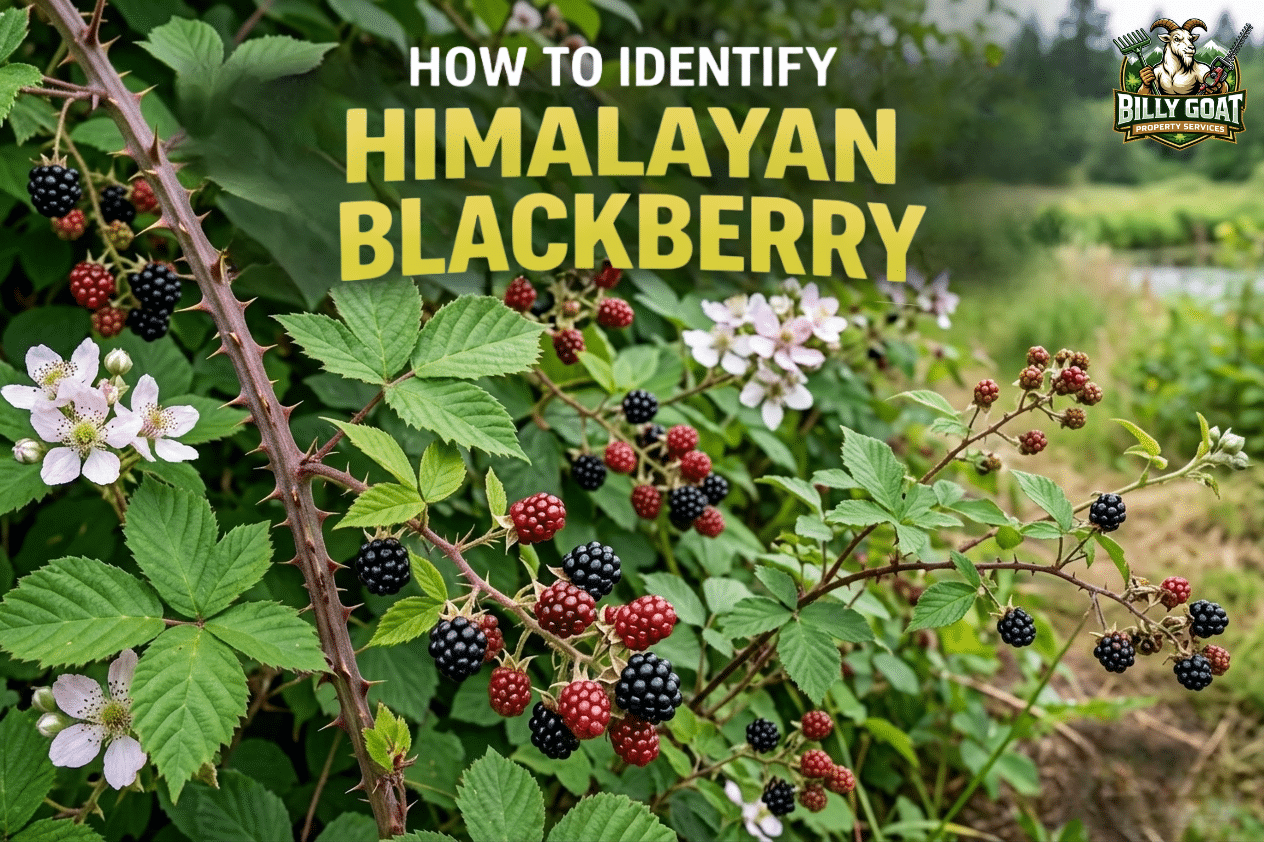
Start with the growth habit. Himalayan blackberry usually forms a large arching mass instead of one neat bush. The canes are strong, angled, and heavily armed.
Oregon State notes that the canes can grow very long in a season, and mature plants often build dense, nearly impenetrable thickets. If the patch is climbing over fences, pushing into lawn edges, or swallowing small trees and shrubs, that is your first big clue.
Next, look at the leaves. One of the clearest signs is the leaf pattern. The leaves are palm-shaped and often have five toothed leaflets, though some leaves may show three. The leaflets are usually oval to elliptic, darker green on top, and lighter underneath. That underside can look gray-green and slightly soft compared with the upper surface.
This is one of the fastest ways to identify Himalayan blackberry without waiting for flowers or fruit.
Then check the stems. Himalayan blackberry canes are not smooth, round, and harmless like many yard shrubs. They are ribbed or sharply angled and covered with stout prickles.
Older canes often look dark reddish or purplish brown. If the patch grabs your clothes and scratches your arms the second you brush against it, that is very typical of this plant.
After that, check for seasonal clues. In bloom, Himalayan blackberry produces clusters of white to pinkish flowers with five petals. Later, it produces glossy black fruit. The berries are edible, which is one reason people sometimes leave the plant alone too long.
But the fruit also helps it spread, because birds and mammals eat the berries and move the seeds to new places.
Compare it with the most common look a likes:
- If the leaves look cut, lacy, or deeply sliced, it may be an evergreen blackberry instead of a Himalayan blackberry.
- If the plant stays low and trails along the ground with thinner, bluish canes, three leaflets, and smaller thorns, it is more likely a native trailing blackberry.
- If it is a normal landscape shrub with woody stems but no hooked prickles, no arching cane growth, and no bramble thicket habit, it is likely not a blackberry at all.
DIY or Professional Help: Which One Makes More Sense?
If the patch is small, new, and easy to reach, a DIY approach can work. That usually means cutting the canes back carefully, digging out the crown and major roots, bagging or hauling debris, and then watching the area closely for regrowth.
Small edge patches along a fence or a single corner of a yard are the kind of jobs many homeowners can tackle if they have thick gloves, long sleeves, eye protection, and time for follow-up.
But DIY gets a lot harder when the plant is mature. These plants have extensive root systems and can resprout vigorously after being cut back. That is the part many people underestimate.
A patch may look gone after one weekend of cutting, then push new growth back up a short time later because the roots are still active. Large thickets, steep slopes, hidden debris, fence-line invasions, and areas near structures or rough terrain usually call for better equipment and a more complete removal plan.
Professional help is often the better choice when the growth covers a large area, blocks access, keeps returning, or needs hauling and site cleanup, along with removal. It is also the safer option when the patch is mixed with junk, hidden holes, unstable footing, or other overgrowth.
In those cases, paying for proper removal can be cheaper than repeating the same failed cutback several times and still ending up with a patch that comes back. That is especially true if you want the area usable again for lawn, planting, sale prep, or regular maintenance.
How Much Does Blackberry Removal Cost in Portland, OR?
Pricing in Portland depends on how much ground is covered, how thick the growth is, how easy the area is to reach, and whether the job includes hauling, root removal, or wider land cleanup.
Portland cost data for land and brush clearing shows that land clearing averages about $1,529 to $4,244, with overall land clearing often running about $610 to $5,000 per acre.
Brush removal alone is listed at around $610 to $1,000 per acre, and half-acre clearing can range from about $300 to $2,500, depending on what is being removed.
For Himalayan blackberry, many jobs land higher than the light-brush side of that range because the growth is dense, thorny, and often tied into roots, hauling, and hard access. Heavy vegetation costs more than light brush in Portland, so a small patch along a flat fence line will cost far less than a deeply overgrown slope or a neglected lot that needs full restoration.
The smartest move is to get an on-site estimate, because photos alone do not always show the real thickness of the canes, the amount of debris underneath, or how much follow-up work the site will need. This is an informed estimate based on Portland clearing data and the added difficulty of dense overgrowth.
Billy Goat Portland Blackberry Removal
For property owners in the Portland area who want the job handled properly, Billy Goat offers blackberry removal, debris hauling, weed control, and broader property restoration services.
Billy Goat Property Service serves Portland and the wider tri-county area, offers free estimates, and brings more than 18 years of experience to cleanup and overgrowth work. That makes it a strong fit for homeowners, sellers, landlords, and anyone dealing with a yard that has moved past what hand tools can realistically handle.
If the blackberry patch is spreading fast, blocking access, or taking over more of the property each season, getting professional eyes on it now can prevent a much bigger and more expensive project later.
FAQ
How can I tell if I have Himalayan blackberry or native blackberry?
The fastest way is to look at the growth habit and leaves. Himalayan blackberry usually grows tall and arching in dense thorny thickets and often has five toothed leaflets. Native trailing blackberry stays low to the ground, has thinner bluish canes, usually has three leaflets, and has smaller thorns.
What does a Himalayan blackberry look like before it fruits?
Even without berries, it is still very recognizable. Look for long prickly canes, thick tangled growth, and palm-shaped leaves with three to five leaflets. Flowers, when present, are white to pinkish with five petals.
Is every blackberry plant on my property invasive?
No. Oregon has more than one blackberry type. Himalayan blackberry and evergreen blackberry are invasive, but trailing blackberry is native to the Pacific Northwest. That is why good identification matters before removal.
Will the Himalayan blackberry come back after I cut it down?
It often will. Oregon sources note that it has an extensive root system and can resprout strongly after cutting. Cutting alone may improve appearance for a while, but it does not always solve the problem long term unless the roots and follow-up control are part of the plan.
When should I call a professional for blackberry removal in Portland?
Call a professional when the patch is large, keeps returning, covers rough ground, grows along long fence lines, or needs hauling and full cleanup. That is usually the point where equipment, labor, and site planning make a real difference. Portland area service providers like Billy Goat also offer free estimates, which help you understand the scope before the job gets worse.
Conclusion
If you are trying to reclaim your yard, the first step is knowing exactly what you are dealing with. Once you can identify the Himalayan blackberry, you can act sooner, avoid wasted effort, and choose the right removal plan for your property.
If the growth is already heavy or keeps coming back, the best next move is to get a free estimate for professional blackberry removal in Portland and take your space back before the thicket spreads even further.
Call Billy Goat Property Services at 503-783-4747 or visit tamemyjungle.com