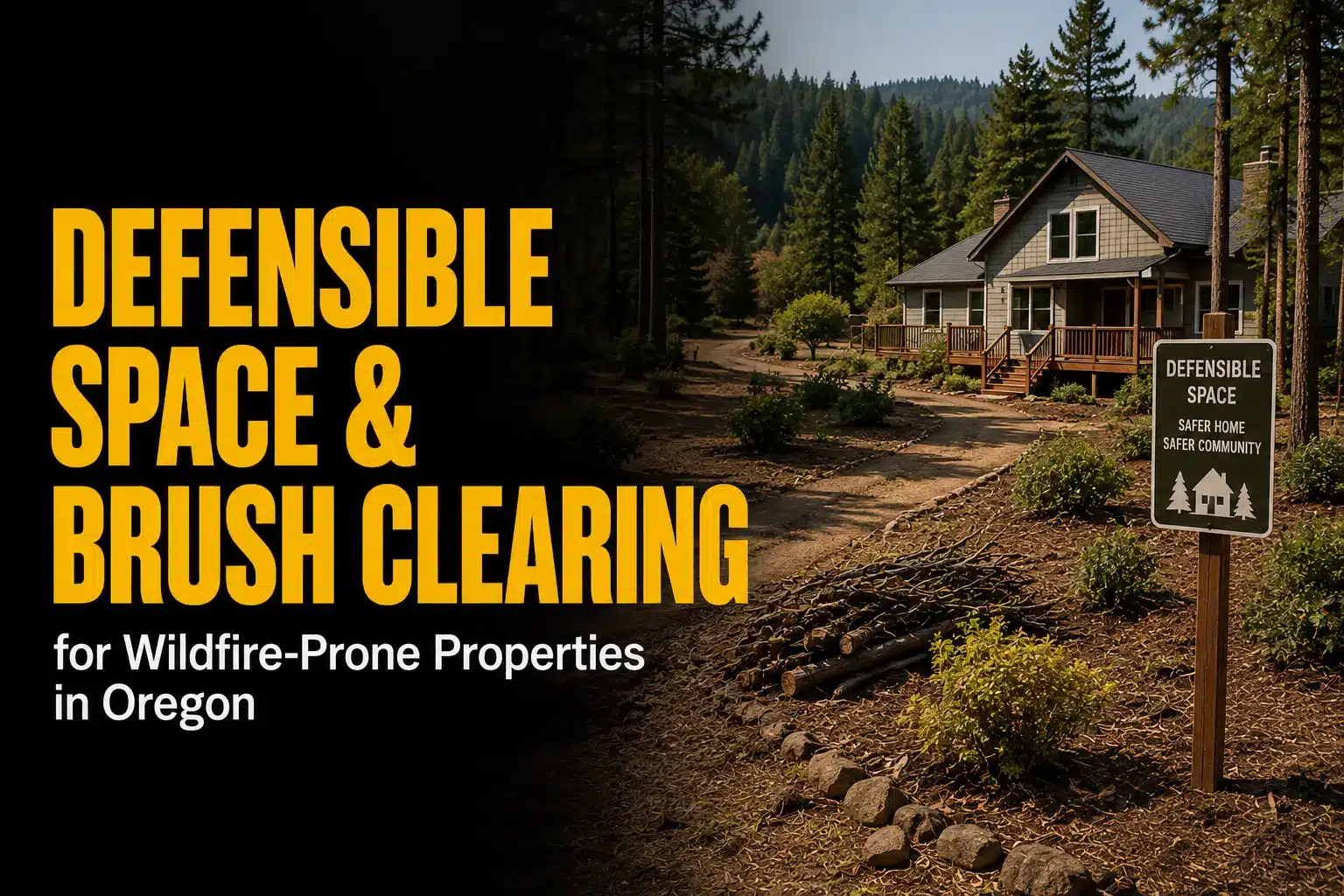
Properties near Estacada, Molalla, and other areas bordering forest land carry a wildfire risk that suburban Portland lots simply do not. Oregon has spent the past several years building out a statewide framework for defensible space, the buffer of cleared, managed vegetation between a structure and the surrounding wildland. Billy Goat Property Services clears the brush and vegetation that defensible space standards call for, on properties across Clackamas and Washington County.
What Defensible Space Actually Means
Oregon’s Office of the State Fire Marshal defines defensible space as the area around a structure where natural or human-made material capable of carrying fire has been treated, cleared, or modified to slow an advancing wildfire and give firefighters room to work. The state’s model code, finalized in 2026 after several years of development under Senate Bill 762, recommends practices including a five-foot noncombustible zone next to structures, spacing tree crowns at least ten feet apart, pruning trees up six feet from the ground, and clearing ladder fuels, the low brush that lets fire climb from the ground into a tree canopy.
Where the Code Applies and How Adoption Works
The defensible space code applies to properties identified on Oregon’s statewide wildfire hazard map as within the wildland-urban interface, developed jointly by Oregon State University and the Oregon Department of Forestry. As of the most recent legislative changes, adoption of the model code is voluntary for local governments rather than a statewide mandate, meaning enforcement varies by county and fire district. Property owners in higher-risk areas can request a free defensible space assessment directly from the State Fire Marshal to find out what applies to their specific property, an assessment that is advisory rather than something we provide ourselves.
What We Clear, and What We Do Not
We handle the vegetation management side of defensible space, clearing blackberry, brush, and ladder fuels from around structures, thinning overgrown brush along the perimeter, and hauling the cut material off site. We are not fire code officials and do not perform the official defensible space assessment itself, that comes from the State Fire Marshal or a local fire district. What we do is get the vegetation on the ground into the condition an assessment or the model code calls for, before or after that assessment happens.
Properties with both defensible space needs and overgrown fence lines or pasture edges often benefit from combining both into a single visit, since the same crew and equipment handle both types of brush clearing.
A Defensible Space Clearing Job Near Estacada
A property owner near Estacada with several acres backing up to timber land had a State Fire Marshal assessment that flagged dense brush and ladder fuels within the recommended clearance zone around the house. We cleared the brush back from the structure, thinned the vegetation along the tree line, and removed ground litter and deadwood that had built up over several seasons. The property owner used before and after photos to document the work for their own records and for their insurance carrier.
A Brush Thinning Job in Molalla
A homeowner outside Molalla wanted to get ahead of a defensible space assessment rather than wait for one, given how close the tree line sat to the house. We cleared blackberry and brush within the closest zone to the structure and thinned growth further out along the property line, following the general spacing and clearance guidance in the state’s model code even before a formal assessment had been scheduled.
When to Call a Professional
A small, cleared suburban lot rarely needs anything beyond normal yard maintenance. Once a property backs up to forest or wildland, once brush and ladder fuels have built up near a structure, or once a fire district assessment has flagged specific clearance requirements, that is the point where professional brush clearing equipment gets the job done faster and more thoroughly than hand tools alone.
For a formal assessment of what your specific property needs, request one directly through the State Fire Marshal’s defensible space program. We are the right call for doing the clearing work the assessment recommends.
Common Questions About Defensible Space and Brush Clearing
Is the defensible space code mandatory for my property?
It depends on your county and fire district. Adoption of the state’s model code is currently voluntary for local governments, so requirements vary by location. Properties on the state’s wildfire hazard map in higher risk categories are the most likely to see local requirements.
How do I find out if my property is in a wildfire hazard zone?
The State Fire Marshal and Oregon Department of Forestry maintain the official statewide wildfire hazard map. You can also request a free defensible space assessment for a property-specific evaluation.
Do you perform the official defensible space assessment?
No. Assessments are provided by the State Fire Marshal or your local fire district and are advisory. We handle the vegetation clearing work that an assessment or the model code recommends.
What is a ladder fuel, and why does it matter?
Ladder fuels are low brush and vegetation that let a ground fire climb up into a tree canopy. Clearing brush from under trees is one of the more effective steps in reducing that risk.
How far from my house does brush need to be cleared?
The model code recommends a five-foot noncombustible zone immediately next to structures, with additional spacing and clearance requirements extending further out. A formal assessment will give you the specific distances that apply to your property.
If your property backs up to forest land or has been flagged for defensible space clearance, contact us for a free estimate. We will clear the brush and vegetation to the standard your property needs, whether that comes from a formal assessment or your own judgment call.